a meeting without an agenda

flyer image

Those of us working in the field of social impact design attempt to enhance neighborhoods, introduce design where it is lacking, and reduce social and economic inequities. Though fellows work hard to serve the public and engage communities, the road to realize projects is often rocky, with the interests of various groups and individuals coming into conflict with each other, the project, or the way in which it is being implemented.

In recent weeks, local politics threw a road block in the way of the housing portion of the Baptist Town neighborhood revitalization project in Greenwood, Mississippi . The road block may have been posturing or it may have been the result of poor communication, but in either case, mud was slung and tempers rose over a deed issue. Diplomacy eventually won out, and the project only suffered slight delays. In the midst of navigating this sensitive situation, a community meeting unlike any I had previously experienced was a refreshing reminder of the big picture goals of this neighborhood wide project.

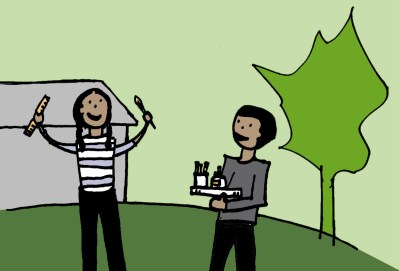
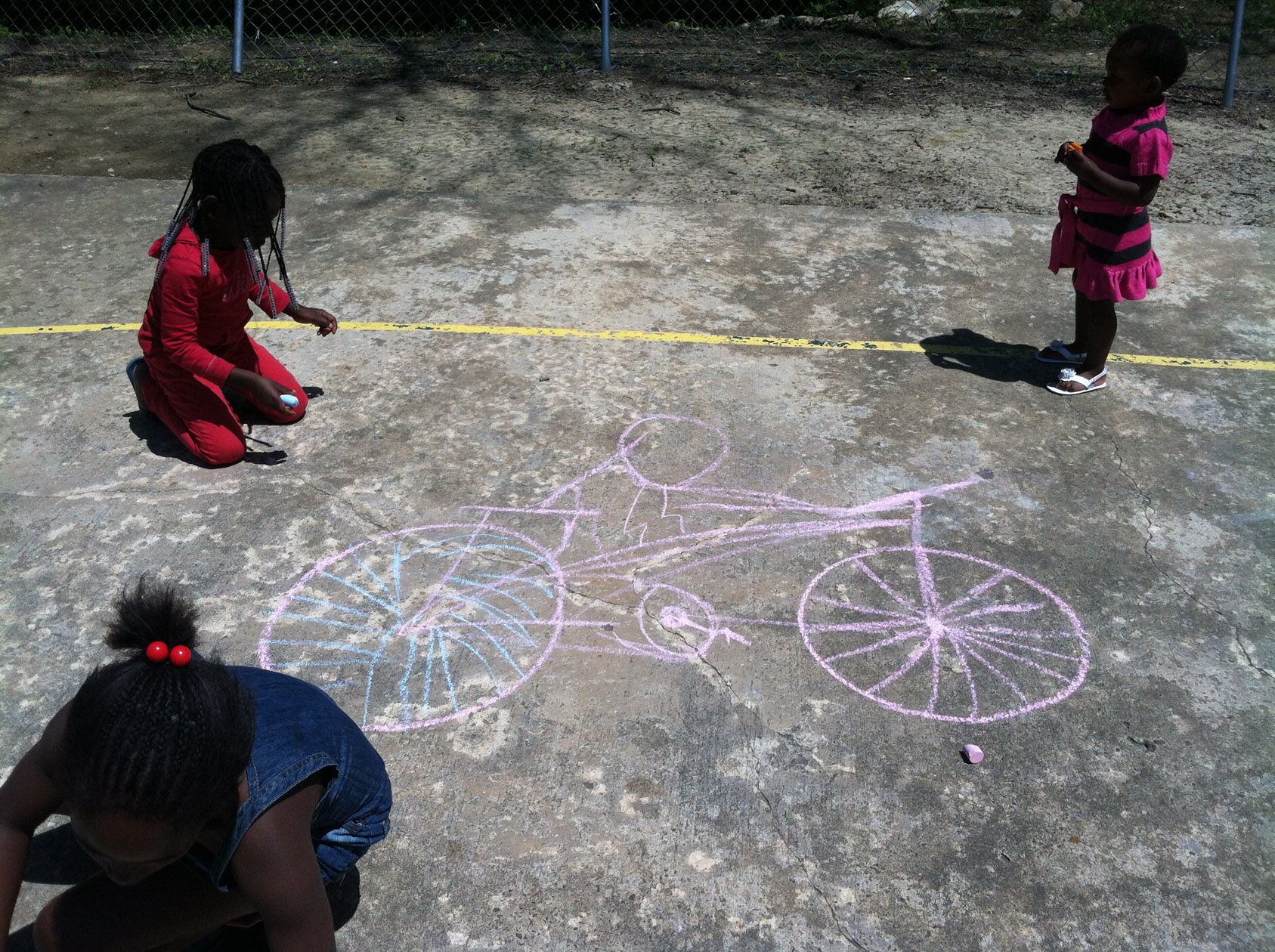
The Kids Only Community meeting on April 20th involved chalk, markers and imaginations. Neighborhood kids were invited to the playground (currently a basketball court, swings and a few spring rockers), to share their ideas of what could exist on the site. Slides and monkey bars were top recommendations, but we also asked students how this park could incorporate their favorite subject in school (The overwhelming response was math!). Project H’s LearningLandscapes served as a great precedent that allowed both the kids and the adults who helped collect feedback understand how a playground could be a fun and active space, while providing opportunities for learning and fit within a limited budget.

We collected dozens of drawings and photographed the chalk art that spread across the basketball court throughout the meeting. Kids were excited to share their ideas, especially when we asked them to dream up things they hadn’t seen before. An addition to the swing set that would make it look like a dragon, an unlimited supply of sidewalk chalk, and hills to roll down were just a few of the ideas we took away.

Though this playground is a smaller scale and less contentious project than the twenty-six home affordable housing effort that is taking place a block away, the enthusiasm and flexibility that the kids of Baptist Town shared with me on Saturday will be a reminder of the best way to approach future challenges as they arise.
bike

another sign of progress

gw cw sign

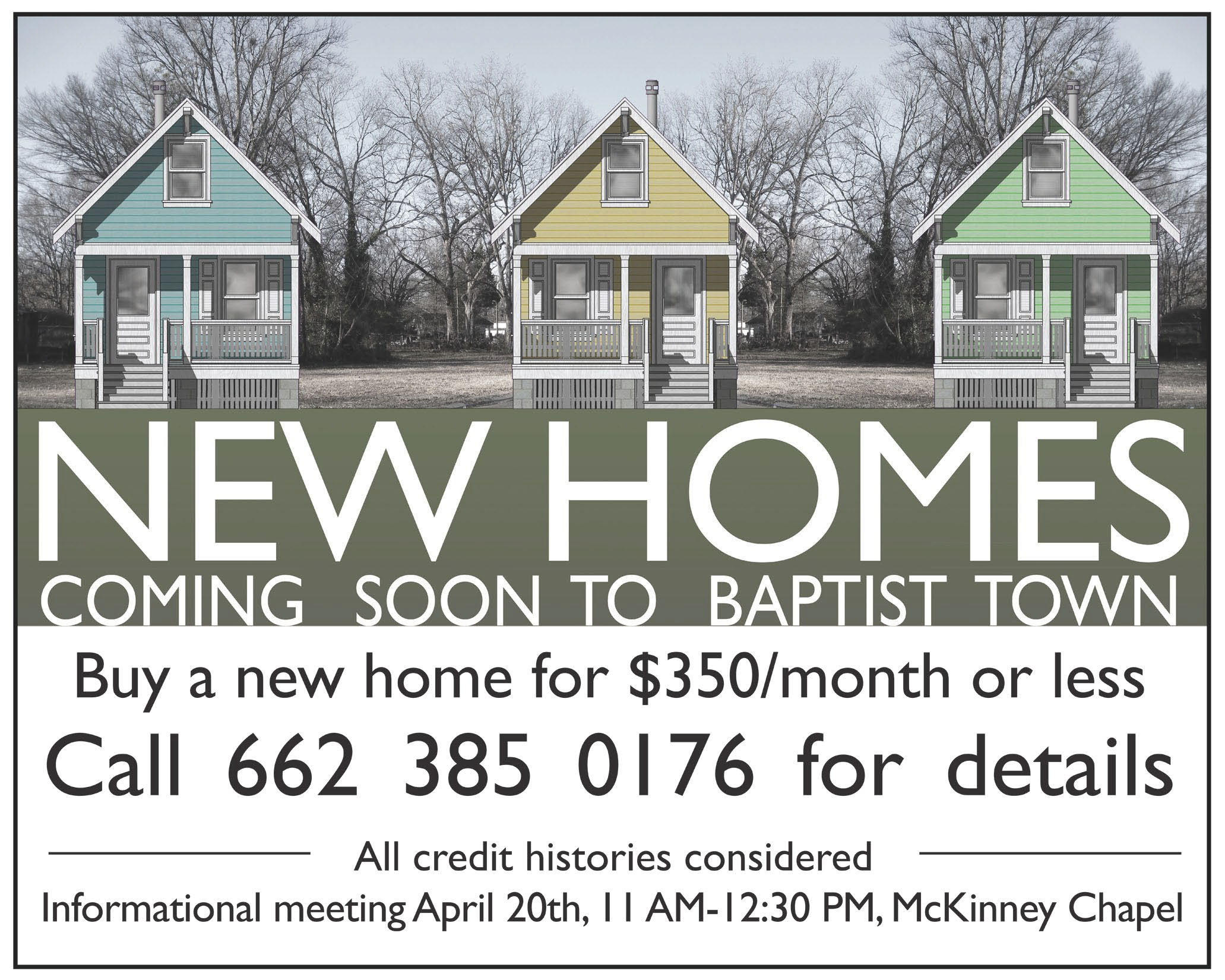
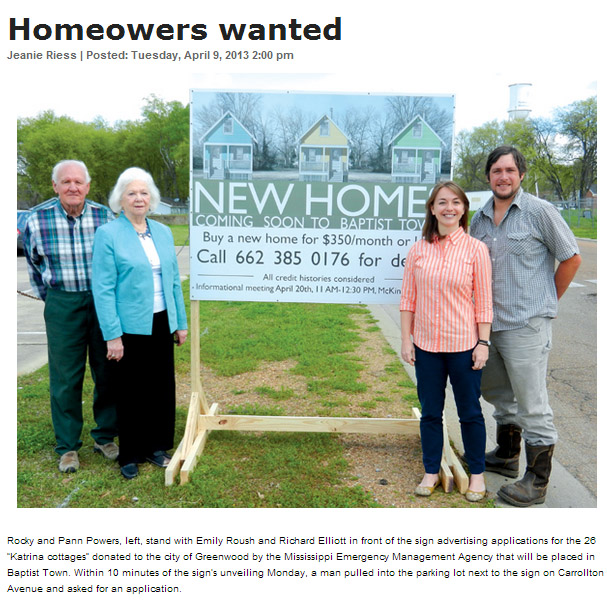
Many thanks to Jeanie Riess, a great writer for our local paper, who covered the unveiling of our new sign and ran this image and caption in the Greenwood Commonwealth today. I have had more than a dozen phone calls already from interested applicants, and two completed applications submitted. Thanks to Jeanie and everyone supporting this project!

progress is…

Cottages for Sale 4_1 small

As I wrote in an earlier post, architect | journalism, a lot of work in public design doesn’t fit within the mold of how architects typically spend their time. Today is no exception, and today, progress is advertising.

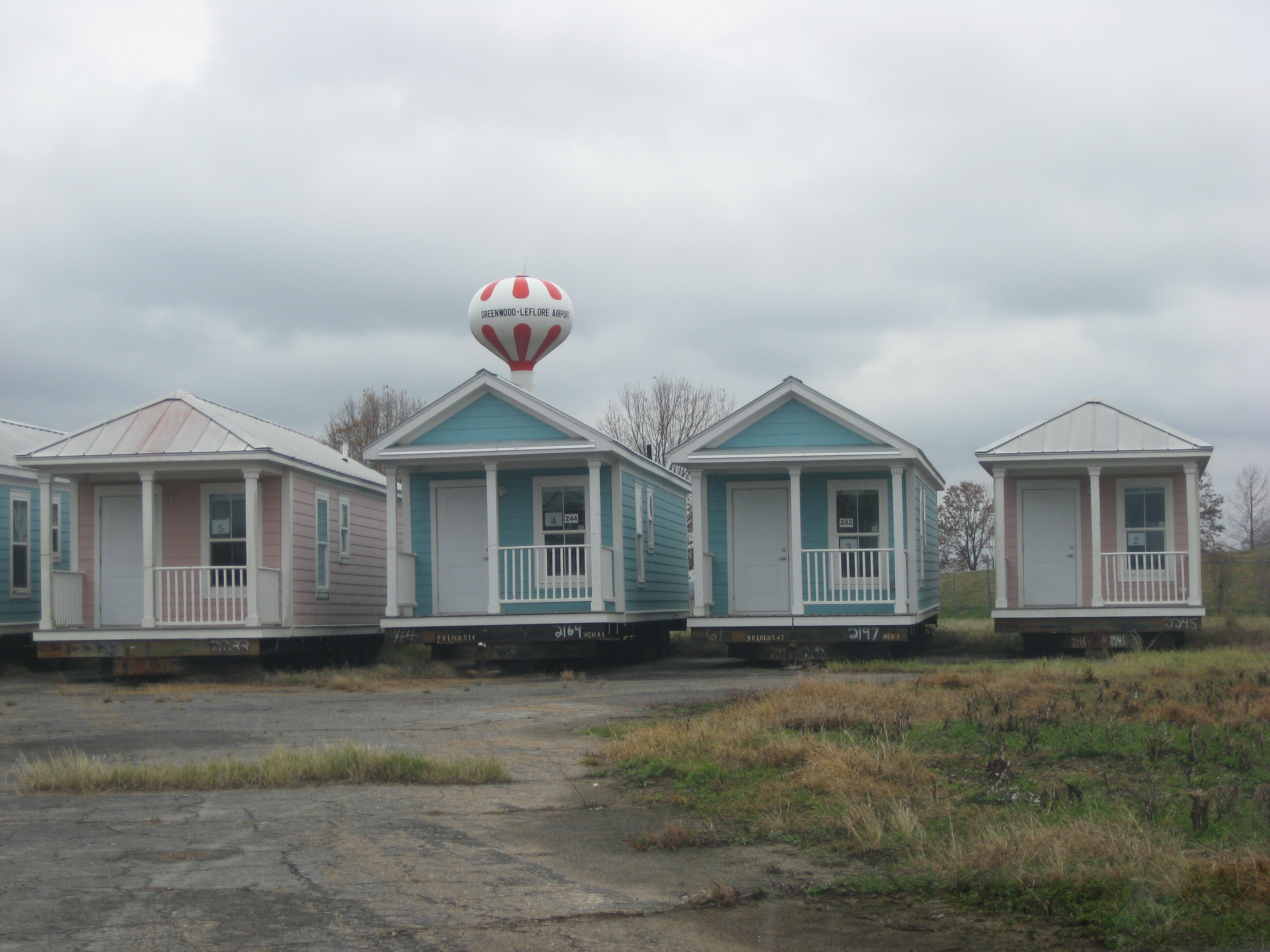
In September of 2011, twenty-six Katrina Cottages arrived at the Greenwood-Leflore Airport. They are still sitting near the tarmac today (pictured below), but thanks to many dedicated individuals this project is one big step closer to becoming a reality. Shovels, hammers, and concrete are still a little ways off, but advertising has begun for these new homes. Thank you to Bruce Tolar for his expert advice. We hope someday our neighborhood will be similar to your Cottage Square!

IMG_3344

looking for something?

pidpagebanner22

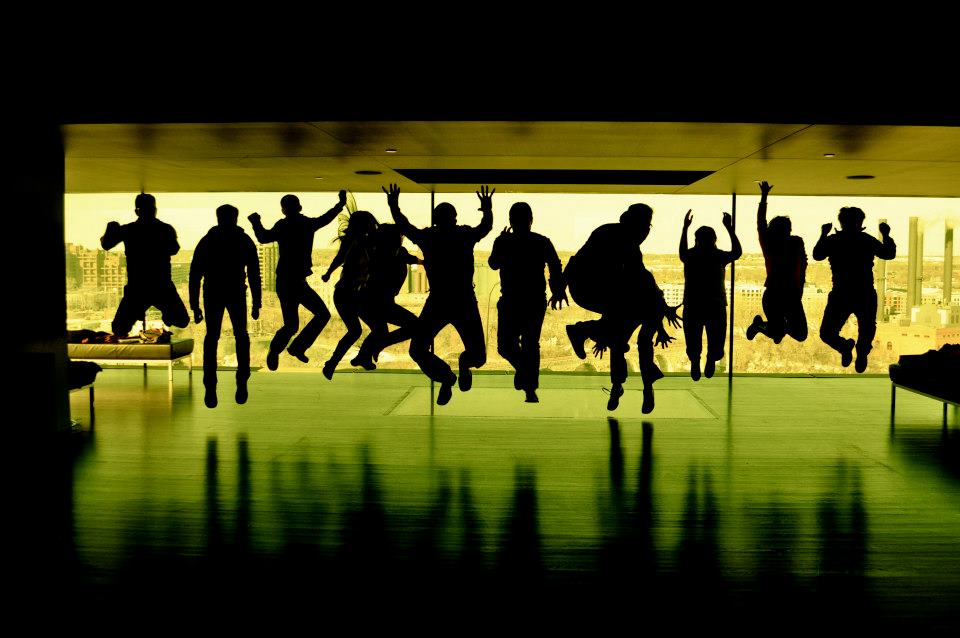
The first Public Interest Design week happened in Minneapolis last week. As one attendee put it, “I found my people.” If you are new to community led architecture, this post is for you. These conferences allow an open format for discourse about architecture, development, design, and the way we work to progress.

The field can sometimes be frustrating because it is difficult to know what is happening in the field and how to take part when so much of the work is through grassroots efforts. The program for last weeks conference documents many opportunities in the field – educational, fellowships, jobs, papers, etc. Most of this is at the end of the document below, so go apply for something new and exciting.

truss mock-up

photo

While I make new friends in Mississippi, Richard is back in Tanzania with our well established crew. We have been working with our contractor, translator and carpenter since 2010. Thank you Dan, Julius (featured image), and Sakai (safety vest)!

Because of our hardworking team, a mock-up of this large, technical truss was completed in one day. Read more about this project here.

8 days a week

2013_OOR_Minimum_Wage_Map

American Public Media’s Marketplace segment yesterday, High Rents, Low Income, included a succinct segment describing the gap between what is an acceptable hourly wage in the US compared to monthly rent rates. The two don’t match up, and something has to give. The options individuals and families are left with include skimping on essentials like health insurance and healthy food, or as a last resort, homelessness. At the community level, businesses and lawmakers should take note of who is leaving and when, taking with them their contribution to the local economy as well as the social fabric.

Some may argue that such problems are a result of laziness, but as the map above shows, 8 days a week still wouldn’t be enough to cover the rent at minimum wage in any state.

architecture | journalism

Today I drew a floor plan, and that was definitely an exception to what normally fills my days. Drawing, modeling, and solving math problems are common conceptions of what architects do (disclaimer: I am not quite an “architect”, but I am getting close). Though the math problems are much simpler than most people imagine (eg: 24 users divided by 1 shower stall per 8 users = 3 showers), creating 2 and 3 dimensional representations of proposed buildings do indeed take up the bulk of young almost-architect’s time. But once again, the daily activities of the architect are turned on their head in the community led design realm. Projects of all sizes and programs involve alternative parties, funding streams, schedules and needs when the public replaces an individual or corporation as the client. Despite this departure, it has been my experience that an architectural education prepared me primarily to be a problem solver – just the skill I need as I tackle the ever shifting requirements of a project like the Baptist Town neighborhood revitalization.

Additionally, my problem solving skills are continually increased by working in proximity with experts from diverse fields. Here in Greenwood, I am getting a behind the scenes education in terms of the legal, social work, and grant management aspects of  new affordable housing development. In Cincinnati, with Village Life Outreach Project, partnerships with doctors, engineers, educators, and writers informed my thinking.

A journalism professor, counted among the unlikely professionals that I have partnered with on a design project, is currently teaching a course that will offer students the same opportunity for diverse learning that I am describing here. Along with a Humanitarian Design course taught by Michael Zaretsky, Elissa Yancey’s journalism class will travel to Tanzania over spring break. The students represent a large cross section of majors and backgrounds, and I wish them all an experience that broadens their perspectives and informs their careers.

Learn more about Elissa’s class here.46321_295966143840228_921837370_n

it’s official

After many months, Google Maps has approved the locations of the Kingigoro Primariy School and the Roche Health Center. If you are ever in East Africa, all you have to do it type the names of these buildings to get driving directions! Alternatively, you can search for these locations today and see the progress Village Life is making. The completed walls and foundation of the new school building are shown below. Richard Elliott will lead EWB-UC students on a trip to construct the roof in April.

Picture 3