The 2012-2014 class of Rose Fellows reflect on their communities, their work, and their personal and professional growth in this video. As each of them speak, the power of the fellowship to bring about innovation and develop design leaders intent on social justice is clear. I’ll miss Nate Poel, Sam Beall, Mark Matel, Sam Carlsen and Ceara O’Leary, but I’m excited to see what the next big thing will be for each them.
Tag Archives: enterprise rose architectural fellowship
final but not finished


Above: MSU CAAD students complete their DESIGN|BUILD: DELTA “final exam”.
While attending the Design for Equity Bruner Loeb Forum in November I met Miriam Gee, a co-worker of Enterprise Rose Fellow Geoffrey Barton. Miriam is an architect, builder, and instructor. Miriam has extensive experience with some of the leading design build programs in the United States including the Asheville Design Center, and Yestermorrow Design/Build School. She describes her career as “inspired by students, yet grounded in real-world design challenges.” Connecting academia with project delivery is challenging and raises questions regarding how students can responsibly gain experience, how to manage client expectations, and how to prioritize the goals of such a project. Check out Build Lightly Studio to see some of Miriam’s completed projects.
In the 3-hour elective course DESIGN|BUILD: DELTA I led this fall at Mississippi State University, the students did not finish construction of our project, but we did meet our goals. As stated above, linking a learning experience to carrying out and completing construction is not a straight-forward process. To succeed doesn’t necessarily mean to build something substantial or even complete.
I think success in this type of project first means defining clear expectations with the client. If the students expect to complete a cost estimate and a build a foundation, but the client is expecting a completed building, everyone will be disappointed. Second, though design build classes have great potential for responding to community needs and being a source of cheap labor, education must remain a priority. Instructors must offer structured guidance, and not rely wholly on the students to be intentional about learning throughout the project experience. Finally, someone on the team must have the skills to lead the project. Carpentry, masonry, and other skills are trades, and it is irresponsible to expect untrained individuals to be able to master or even manage these skills in a short period of time.
In DESIGN|BUILD: DELTA, the first half of the semester the goal was to design and oversee construction of a new, code compliant entry area for the Baptist Town Community Center. In the second half of the semester, students paired individual goals (learning to weld, calling material suppliers on the phone, using a drill, and creating material and cost schedules) with the goal of designing and partially building a railing system that is functional but also sets an inspirational tone at the new community center.
at home in greenwood
On Thursday, December 18th we celebrated the first families moving into the Baptist Town Cottage Project with a ribbon cutting ceremony. I was moved by the number of people who attended. Throughout the project, support has come from numerous individuals and organizations. I think that this generosity is rooted in an understanding that home is about more than walls and a roof, it is an avenue to financial stability and physical and emotional health. Just as important, I think the commitment that the larger Greenwood community has given to this project shows that a home is also what surrounds the structure. Healthy homes will lead to a more vibrant and equitable Greenwood.
Thank you Greenwood! For a video of the day visit Mississippi State University’s website where the Office of Public Affairs covered the ribbon cutting ceremony.


Photo credit Bryn Stole
ladies in the landscape


The result is both process and product. Brantley designed and purchased all materials for the garden, the EDF advertised the training program, and over the course of three days Brantley provided training in landscape installation and maintenance techniques to a group of eight women who are currently seeking employment. The result is the functioning storm-water management garden pictured below.
By weaving together social, environmental, and economic factors, this small grant is having impacts at a variety of scales. The natural filtration provided by the garden improves the quality of water as it enters our waterways, decreases the use of concrete or pipes, and will be a beautiful natural space between the new homes in Baptist Town. For the women involved in the program, not only were they compensated for their participation, they are being connected to potential employers who are seeking people with the skills they obtained through this program.
The last step in the project is a brochure that will document our process and our storm-water garden. We look forward to sharing this information with other development projects in the Mississippi Delta, and hope that this pilot project grows into something bigger.
Building upon my last post, this project underscores the interwoven nature of social and environmental goals and outcomes. When we collaborate in unexpected ways is when we best leverage our knowledge and our resources.
fellowships are for the field
The training of architects has always been rigorous, but public interest design requires all of the essential architectural skills plus financing, policy, community engagement and organizing skills….Fellowships provide an alternative career path, arming these individuals with skills, resources, and network to lead the future of public interest design practice.
– Katie Swenson, Vice President of Design at Enterprise Community Partners
In a blog post on October 22nd, Katie Swenson summarized some of the ways in which fellowships are important in the development of thought leaders, a benefit that contributes to the field as much as the individual. Read all of Katie’s blog post on Impact Design Hub.
I’m also glad to see that Greenwood, MS provided a great backdrop for Katie’s picture!

cottage construction
The Cottage Project is under construction! In only a few weeks, eight homes have been placed on newly constructed foundations. Three additional foundations are currently underway, while Richard and I work to get the first eight move-in ready.
can customization be affordable?
Thomas Fisher, Dean of the College of Design at the University of Minnesota and an important critical mind within the field of architecture, was recently a guest on Enoch Sear’s the Business of Architecture. Per the norm with Fisher, his insights into architectural practice are framed within a broader economic picture that brings an interesting perspective. During the discussion, Fisher cites economist Jeremy Rifkin’s writing about a movement from “a mass production, mass consumption economy of the 20th century in to what he calls a mass customization economy of the 21st century.” As a concept, “mass customization” seems antithetical, but real world examples are everywhere. Smart phones are probably the most prevalent example. Each phone is mass produced and has certain similarities, but the exterior, screen display, apps, and functionality are controlled by the end user (and at this point, we wouldn’t have it any other way).
Closer to home, the Baptist Town Cottage Project has provided some opportunities to practice mass customization through a modular, affordable housing effort. Though each size floor plan is identical to the next, various interior finishes and exterior colors allow home owners a level of individualization. Additionally, each home owner was paired with a team of architects and designers during the Enterprise Rose Fellow Alumni retreat last spring. The teams spent an afternoon together, each creating a custom carpentry detail that will be built and installed as the slats between foundation piers and the railings around stairs and porches. Today, we are excited with the project progress as eight foundations are currently under construction and the Greenwood-Leflore Fuller Center for Housing was recently awarded a $10,303 grant from the GE Volunteers Foundation to construct our “mass customized” designs.
For more about this concept, listen to Sears and Fisher’s entire discussion.
no, thank you, de’vante
I recently met De’Vante Wiley (featured in the audio below) while hosting a group of high school volunteers participating in the Summer Youth Institute, an experiential learning program that explores Mississippi society, history, and diversity. De’Vante began working to improve his community at a young age, organizing a community garden in Baptist Town when he was sixteen. I was glad to see that Southern Foodways Alliance ran into him also, wrote about him in this blog post, and provided the link to the excellent interview they did.
A couple of weeks after I met De’Vante he stopped by the community center. Just as he succinctly speaks about some of the most challenging social aspects of life in rural Mississippi, he also transcended one of the most challenging aspects of community work and said, “On behalf of the Baptist Town community, thank you for the work you’re doing.” From an outsider perspective, public interest work is warm and fuzzy, but the reality is that it is political, never complete, and addresses realities too complex to equal unanimous support from any large group.
Still, public interest designers conduct meetings, surveys, studies, games, and events to try to take into account the needs and aspirations of their client communities. Through this process to find the best possible architectural response, negative feedback is sometimes the only voice that is heard, while those pleased with an initiative stay silent. Positive feedback such as De’Vante’s “thank you” feels good on a personal level, but more importantly, indicates to social impact designers when a project is on the right track.
a fresh coat of trust
Over thirty people attended a meeting at the new Baptist Town Community Center on Monday night, by far the most that have participated in this type of meeting since I began working in Baptist Town last year. Even better, a lot was accomplished at the meeting with the selection of an advisory board for the center, collecting ideas and volunteer commitments from residents, and celebrating a fresh coat of paint on the building’s exterior with games and snacks. It felt like an important moment in the course of this neighborhood revitalization effort.


Often when “community engagement” is discussed, the concept is sugar-coated. It is described as meetings where information flows freely and individuals rally around a common cause. The reality of this type of engagement is often far from such a utopia. Issues are rarely cut and dry, and it is difficult to develop a clear understanding of community member’s needs and hopes. Further, many engagement activities fail to attract more than a few participants. When community members do arrive, factions sometimes develop or certain individuals are antagonistic to the point of inhibiting discussion. I have experienced this many times in a variety of locations, so what made last nights meeting different? Trust.
When I arrived in Baptist Town much had been promised and resources were aligned to deliver on these promises, but there was no one in place to oversee actual implementation. We were able to complete infrastructure, park, and signage projects in 2013, and this went a long way toward building trust within the neighborhood, but it’s been months since these projects were completed.
Last week, a group of painters from Resurrection Catholic Church in Wayne, Ill. teamed up with Sherwin Williams to repaint the building we had newly purchased for the community center. From a faded and scratched blue to a brilliant red (selected by community members through a voting process), the building has new life. I think that the trust we build by making good on promises is the primary factor in garnering both the participation and the communal spirit of meetings like the one we held last night. This is encouraging as we prepare to break ground for five of the Cottages (at last), but also a reminder that for the communities we engage with as social impact designers, regular, visible signs of our work are necessary, no matter how small or what form they take. Otherwise it’s perceived as just a lot of talk.


design futures should be in your future
Hosted by a collaborative of university based architecture programs, the second annual Design Futures Student Leadership Forum conference was hosted at Tulane University last week. Over sixty students from ten universities were given a unique view of the field, meeting public interest design leaders and hearing about their projects, but further, participating in workshops that asked questions that welcomed the next generation of public interest designers to be a part the discourse that leads, defines and sometimes plagues this field.
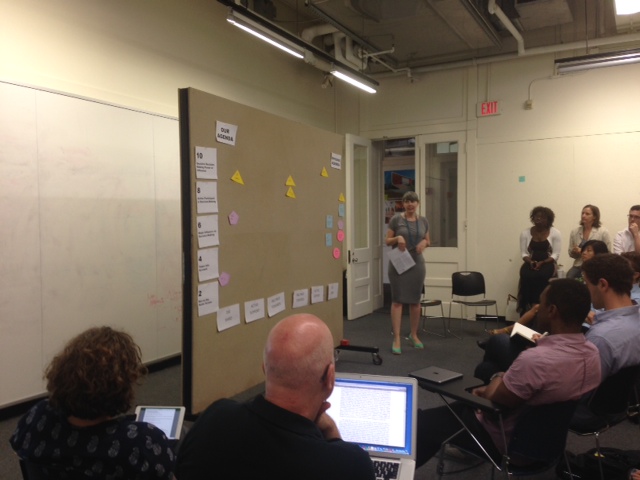
Sessions included topics such as funding sources, ethics, power structures and skills utilized in social impact design. By inviting thought leaders and asking them to create sessions that were workshops more than lectures, what resulted was powerful stuff. Students got a look at one of Katie Swenson’s Enterprise Rose Architectural Fellowship draft budgets, a power mapping exercise Christine Gaspar and the CUP (Center for Urban Pedagogy) staff had used to understand the agendas of involved parties related to unregistered hotels in New York City (pictured below), and insights from Theresa Hwang on ethical decision making related to the work of Skid Row Housing Trust, among others.
John Peterson, of Public Architecture, led a session that was designed for students, but was equally interesting to early career attendees. The workshop guided participants through a series of exercises that worked backward, from long range career goals, to options that can be pursued today to develop the skills that will make achieving those goals possible. As a panelist, along with Tulane City Center’s Emilie Taylor and UT Austin’s Nicole Joslin, I shared that though my time in architecture firms was important to my professional development, my time as a waitress taught me to talk with unhappy customers and to “know when a fire is a fire”, a skill that helps me keep projects moving forward even as challenges arise.
Though Design Futures was created as a conference for students, the format positioned presenters to discuss their work in a critical and reflective way that engaged attendees of all ages. Next year’s Design Futures at the University of Kansas is on my list of conferences not to be missed in 2015.
 architecture | equality