want to be a public interest architect? here’s one path

The new class of Enterprise Rose Fellowship opportunities was recently announced. Six exciting positions in Boston, Oakland, Minneapolis, Los Angeles, Detroit, and Slayton, MN will offer early career public interest designers opportunities to accelerate a career path in design leadership and community engagement.

More information is below, and the detailed work plans are available on Enterprise’s website.

fellow-cornerstone-group-250x150

Applications are now open for Rose Fellowships for 2015-2017. Apply by July 10th 2014!

Questions? Contact the Enterprise Rose Architectural Fellowship office at (781) 235-2006 or rosefellowship@enterprisecommunity.org

The highly competitive Enterprise Rose Architectural Fellowship develops the next generation of leaders in community- based design. Rose Fellows take part in a unique three-year experience offering unparalleled learning and networking opportunities. As integral members of their host organizations’ staff, fellows gain practical experience in site acquisition, site planning, architectural design, developing financial pro-formas, applying for financing and obtaining public approvals. Fellows also typically help their hosts improve standards and practices for design excellence, sustainability and community engagement. Rose Fellows also gain a national support system of colleagues who share their passion for public interest architecture and community development.

As full-time employees of their host organizations, fellows earn an annual stipend plus the standard insurance and benefits package provided by their host organization. The stipend for fellowships beginning in 2015 is $50,000.

Timeline

May Fellowship opportunities posted
July 10 Fellowship application deadline 11:59 p.m. EST
September Finalists selected
October Interviews/Final decisions/Notifications
January 2015 2015-2017 Fellowships begin


a goal we can agree on

Working in rural areas, particularly communities in which little new development has occurred for many years, often presents challenges that surprise me despite extensive experience in these settings. I am presented with points of view, biases, and opinions that I could not anticipate. In the community of Houlka, we have received lots of support and positive feedback, but we have also gotten a lot of questions over the last few weeks. Primarily, “Why aren’t the lines straight?”

Conceived of as a means to clarify uses (parking, driving, biking, and walking) within the square, as well as an eye-catching way to draw visitors from the Tanglefoot Trail into downtown, the student design features undulating yellow and white lines for a wide bike lane and walking area. Though this functional public art  is as unexpected to Houlka residents as the desire for only straight lines is to me, there is one thing we can easily agree on: a design that will decrease the risk of collisions between vehicles and bicyclists or pedestrians.

A little research reveals that from rural to urban and across the country, many issues are constants. In San Francisco, Ogrydziak Prillinger Architects is working toward similar goals, and even has proposed a solution that shares some of the traits of our downtown Houlka project. An image of their proposal is below, alongside recent photos of the CREATE class in New Houlka. 

Read more about Ogrydziak Prillinger Architects concept on Fast Company Magazine’s website. 

New Houlka photo credits: Leah Kemp

who are all those people?

The Enterprise Rose Architectural Fellowship began in 2000. As of January 2014 there are now 50 combined current and alumni fellows scattered around the country leveraging design to improve the state of affordable housing and community development. Last week, they convened here, in Greenwood, Mississippi.

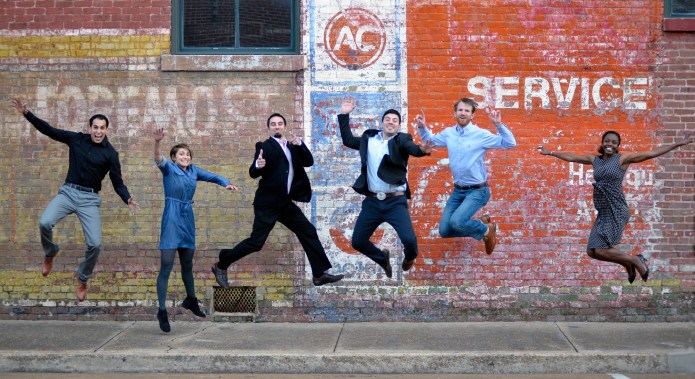
As our large, energetic group was seen around Greenwood I overheard many locals ask, “Who are all those people?”. The answer is those are my people. I am more proud to be a part of this group than any other. I am proud because though we have diverse methods and work within a variety of frameworks, we share a commitment to providing our expertise to under-served populations, to working toward equitable housing solutions, and building partnerships that will result in stronger communities. The Fellowship has a legacy of excellence, and what is magical about this is that in order for any of us (whether an official “fellow” or an ally in the social impact design field) to achieve his or her goals, positive change within the communities we serve is a prerequisite. 

Many thanks to Enterprise Community Partners and Katie Swenson for giving Greenwood the opportunity to host this event.

This slideshow requires JavaScript.

Here’s a little bit more about our week:

Monday through Thursday afternoon, current fellows spent time together discussing their work and the challenges they encounter. We visited Mississippi State University’s College of Art, Architecture and Design where the fellows provided feedback to students in a class I co-teach with Leah Faulk Kemp of the Carl Small Town Center, and four fellows gave a lecture to share their work. We toured Baptist Town and the projects I have been dedicated to for the last year, and we visited an ancient swamp, the BB King Museum, and the first Freedom Trail marker in memory of Emmett Till.

Thursday evening we were joined by alumni and special guests at the delicious Delta Bistro to kick off the weekend. We spent the day Friday discussing the future of the Fellowship, and in break-out sessions related to the diverse work fellows lead. The weekend wrapped up in Baptist Town on Saturday where fellows put their expertise to work, meeting one on one with future home owners to listen, draw and provide design assistance.

Photo credit: Harry Connolly

cottages not forgotten

It has been a long time since I posted about the Cottages, donated to the City of Greenwood for use as affordable housing, and a big part of my fellowship work plan. This is because a resolution needs to be passed by the Mississippi legislature (typically in session from January through March) to allow the Cottages to legally end up in the hands of the organization that will install and sell them. As with many affordable housing projects, we have run into unexpected snags, policy that never predicted our specific circumstance, and skepticism. A recent letter to the editor of the Greenwood Commonwealth voiced some very real concerns about the homes regarding their durability, safety in regards to resident health, and cost. As I continue to build relationships with our legislators and we hopefully move closer to successful passage of our bill, this letter also provided me with an opportunity to publicly respond to these concerns. Below are some important facts about the cottages and this project that I highlighted in my response in a letter to the editor run on Sunday, February 9th, 2014.

  • The Mississippi Cottages are high quality homes. They were designed not as temporary shelters, but as a way for Gulf Coast communities to build back better than they had been before Hurricane Katrina. I spent a significant amount of time in the homes while working in Biloxi, and I would not be dedicated to this project if these homes were not of a quality that I would live in one myself.
  • From a technical standpoint, it should be clarified that the homes are “modular”, not “mobile”. This means that they conform to the highest building standards, and will meet all code requirements in any area of the United States.
  • In regards to finances, the Cottages themselves were donated, but the land on which they will sit, their foundations, driveways, steps, and mechanical, electrical and plumbing connections were not. These items combined will cost an estimated $25,000 for a two-bedroom Cottage. Pending passage of a bill currently in the MS legislature, the Fuller Center will sell the homes to applicants for only the costs that they invest in the items listed above. The mortgage the Fuller Center will offer will be for 15 years with 0% interest. It is our projection that the actual per month cost will be approximately $120-$160 in mortgage principal payment plus $60-$120 in monthly payments for insurance and property taxes.

can community action be easy?

The Greenwood team returned from the Sustainable Cities Design Academy last September inspired and with new knowledge about how to create sustainable change throughout the city. Though we each have incorporated the discoveries made at SCDA into our ongoing work, team members expressed concern about fitting additional important projects into our already busy schedules. Through the fall we formulated a plan to avoid letting plans to positively impact the health, education, and social and economic equity of area residents fall by the wayside.

SCDA team members started by inviting others to be part of a group that would be committed to sustainable efforts in Greenwood. In subsequent meetings the group decided that we should find our footing and identity through light, quick, cheap community projects. Members of the group have committed to completing one small but visible project (taking only 4-8 hours to plan) each month in 2014.

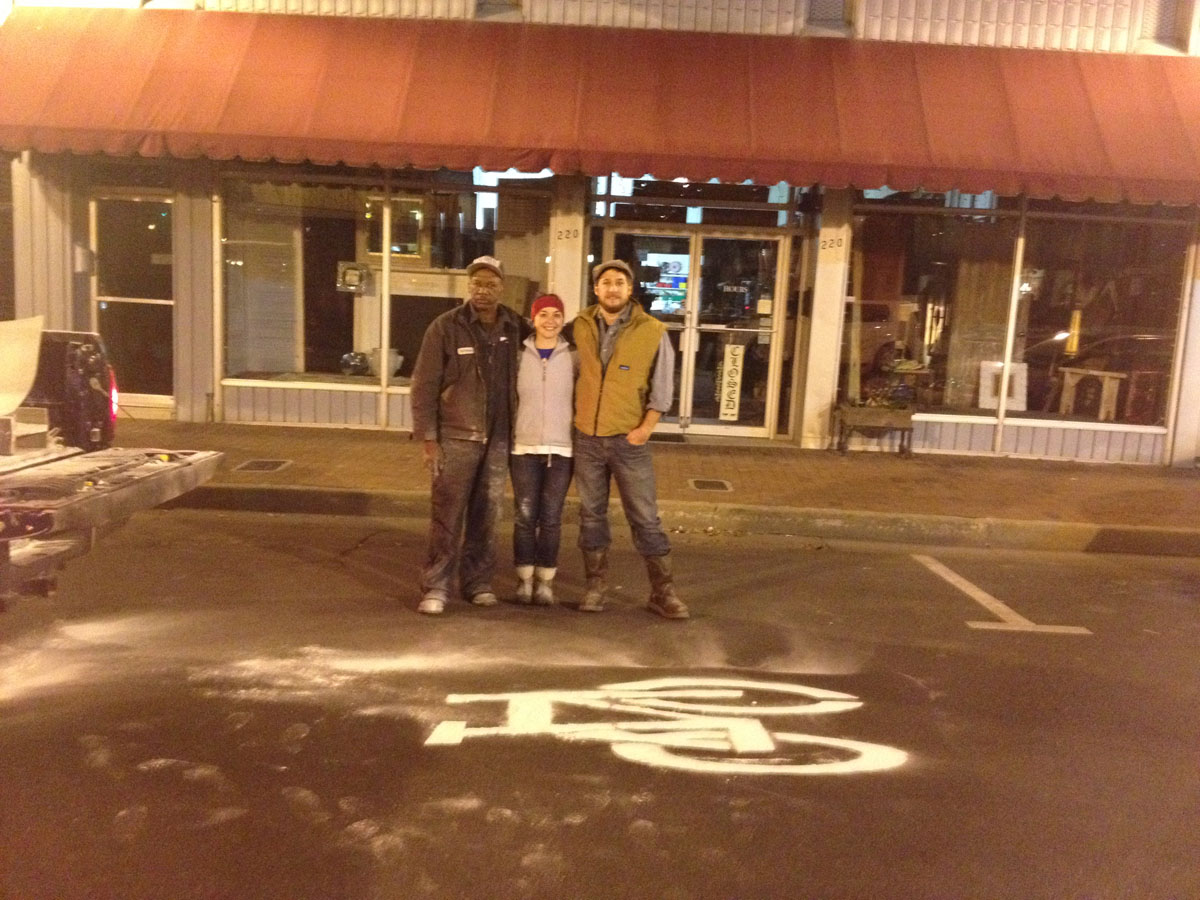
Expanding the knowledge, interest and availability of bike culture is a topic that has continued to come up in sustainability conversations. Toward that end, four of the group members chalked “share the road” symbols on a route throughout downtown and an adjacent residential neighborhood. This route could potentially become a permanent biking route if the City sees public support for our project. For now, we got a lot of attention from curious drivers who saw us out with the stencil and chalk spreader on a chilly Thursday night. The following Saturday, group members met to bike the route together, similar to the Critical Mass rides that are common in many cities. We had a small turn-out, but we learned a few things about bike lanes, chalk spreaders, and our community through the process. Most importantly, many people have asked if any more rides are planned. There aren’t any yet, but we are working on our February initiative now, and are excited to see how the year unfolds.

January recap:

  • Chalk “share the road” symbols and bike ride
  • Time: 4 hours
  • Project team members: 4
  • Project cost: $7.75

Thanks to Richard Elliott and Davis Pratt for the photos.

jobs today, houses tomorrow

The Baptist Town neighborhood has austere statistics in terms of the poor quality of housing, low home ownership rates, and homelessness. These challenges largely inspired the Baptist Town Neighborhood Revitalization and are among the primary reasons that my fellowship exists. Despite this great need, plans to install a minimum of eleven new homes in the neighborhood could not be brought to fruition this year for a number of reasons. After initially being devastated by what felt like a failure, my hosts and I rallied around the myriad other ways to positively impact Baptist Town. Safer, more attractive pedestrian routes were created at the entry points to the neighborhood, we completed two parks, a playground, new signage throughout Baptist Town, and held the largest Community Day celebration to date, GOODat Day.

Large park and playground

New seating, shade structures, and the playground in the background.

Each of these activities reminded us that as important as housing is, it is one component of the multi-faceted approach needed to bring about long-term change in this neighborhood. One of my hosts, the Greenwood-Leflore Economic Development Foundation, provided the leadership that allowed us to respond to one of the other great needs in Baptist Town: employment. Building upon the skills residents shared during GOODat Day, we offered a competitive small business grant. We awarded the grant two weeks ago. Along with the funds, two grant winners have received business cards and will participate in four question and answer sessions with local experts who can help guide their fledgling businesses.

Angela and Roger front page news

Economic Development Foundation Executive Director, Angela Curry, and GOOD@ Small Business Grant winner Roger Williams made front page news

Our grant winner has already reported that because of the equipment he was able to buy with the grant funds he has been able to continue detailing cars in cold weather and his profit margin has increased. Though we are working hard now in hopes of beginning the housing component of the neighborhood revitalization as early as January, this work has given us insights into how to more holistically respond to the needs of the Baptist Town community. As the first year of my fellowship quickly wraps up, I am looking forward to a second year in which new homes are realized, and we can support this work through education, health, and employment related initiatives.

upcoming ACSA conference

102-annual-homepage-programpagebanner

The Association of Collegiate Schools of Architecture’s call for this years papers invited submissions on a variety of topics, all related to the global nature of architectural practice today. The number of topics related to socially impactful work is encouraging. Even more exciting is the acceptance of a paper that Leah Faulk Kemp, Assistant Director of the Carl Small Town Center (CSTC), and I co-wrote. Our paper, titled Building Social Building, presents four lessons learned through the work of CSTC as instructive in implementing community driven design projects. We can’t share the paper until after our presentation, but here are some soundbites:

  • Public Interest design has trust issues.
  • Public interest architecture is public; this means it’s political.
  • Social impact design is about more than three bottom lines.
  • Social impact work must be impactful.

We will share more about the paper and our presentation in April!


awesome GOODat day video

As soon as we thought up the GOODat theme for Baptist Town Community Day, I thought of Dash. A long time resident of the neighborhood, he films many of the talented rappers in the neighborhood, and he is good at it. Thanks to Dash, we have great documentation of an awesome day.

More video clips from GOODat coming soon.

soft metrics

I believe strongly that design and thoughtful implementation add value to every project, but social impact work takes place in such a complex and variable environment that tracking outcomes based on specific projects is rare and imperfect. As I mentioned in my last post, we may not even know of the positive or negative ripple effects our work is having. Despite this, I also believe it is the responsibility of social impact designers to make an effort to document metrics associated with their work.

If we want the field of public interest design to grow, and funding to be dedicated to the projects and the jobs we believe make the world a better place, there is no alternative to demonstrating a compelling value proposition.

Rebekah Levine Coley, a professor at Boston College’s Lynch School of Education, and her colleagues from Tufts University make just such a proposition through a six-year long study that tracked the development of 2,400 low-income children within poor families. The research concluded that “the quality of a child’s home predicted academic success and susceptibility to emotional and behavioral issues” more strongly and consistently than any other factor.  As Emily Badger writes in her report on the study, the breadth and depth of the research is important because it indicates causation over correlation. Read an excerpt below or the entire article here.

In retrospect, that study amassed precisely the kind of data you’d need to understand how housing itself – not the social environment of a “family home” – might influence children. The study recorded whether a home was rented or owned, or rented through public housing or subsidies, how affordable it was relative to a family’s income, how often families moved from house to house, and the quality of the property. Researchers looked for working refrigerators, holes in the wall, rodents, functioning heat and hot water, adequate light and fresh air – many of them signs of poor-quality housing outside of a family’s control. All of the families were low-income, but some had considerably more run-down housing than others.12837889-old-and-weathered-grey-barn-wall-with-empty-hole-from-broken-and-missing-barnwood-board-showing-aged

Controlling for other factors like a parent’s employment status and income, Coley and her co-authors concluded that the poor quality of housing more strongly and consistently predicted a child’s well-being than all of those other housing characteristics (including whether the home was considered “affordable” to the parents or not). Children in more derelict housing had lower average reading and math skills. They had more emotional and behavioral problems.

The information presented in this study is important in gaining traction for the broad assertion that where a person lives shapes who they are. As stated above, the breadth of this study is important, but public interest designers, rather than be daunted by the idea of studying 2,400 of anything, should see their own projects as an opportunities to reinforce the study on a case by case basis.

I am new to metrics, and am beginning to delve deeper in two ways. First, by frequently asking myself, “What are the intended outcomes of my work in Mississippi?” I have tasked myself with assigning three specific outcomes to track to the Baptist Town Cottage project by the end of November. I will then measure these outcomes before, during and after construction.  Of those three, I would like one of them to be a “soft metric” – something that is not numerical, hard to measure, and tied to well-being similar to Coley’s study.

what’s your GOODat?

When Enterprise was awarded eight $5,000 grants from the Fetzer Institute to be used for love and forgiveness based events, I had a little trouble explaining to the local team what this meant. It turned out to be a question of semantics though, and we moved to framing the question of love in the context of value. What surfaced through this conversation was the importance of valuing oneself, and that this is a prerequisite to being a parent, child, employee, employer, teammate, neighbor, and human who is loving and forgiving. One step further, we asked ourselves how we acknowledge value, or skills and talents, across cultures in the United States. The answer was in the simple phrase, “You are good at…..” or “I am good at…..”

Based on the discovery of GOODat, and the possibility for spreading love that it brought, we began planning the third annual Baptist Town Community Day around a theme of asking and showcasing what the residents of Baptist Town are good at. We asked each other in meetings, “What are you good at?”, and my co-planner Carl Winters and I asked people as they walked, drove or biked down the street, “What’s your GOODat?” Sometimes people were uncomfortable with the question, sometimes they had lengthy answers, but what became clear is that the residents of Baptist Town (and Greenwood) are GOODat a lot things.

Activities throughout the day were planned around the responses to, “What’s your GOODat?”, and as we finished setting up, neighborhood kids were already showing how good they are at jumping and playing. After that, the day officially kicked off at 11 and residents began to visit booths set up by the Leflore County Health Center, the WIN Job Center, and the Harvard Community Development Project. At each booth, important information was available, as well as raffle tickets for door prizes. The cost of a raffle ticket? Answering the question, “What are you GOODat?”

Face painting also began at this time, and Keyauna Gatston showed her artistic skill throughout the day.

The most common answer to the GOODat question was “cooking”. Residents volunteered to cook and serve chicken, ribs, hot dogs, hamburgers, baked beans, cole slaw, and fruit. Willie Fisher, shown below, began manning the grill at 8 AM and was still serving up chicken and ribs when I left in the evening.

While lunch was being prepared, the DJ opened up the mike to anyone interested in sharing a musical talent. Lady Trucker, a professional singer, got the crowd dancing with her music, and she was followed by a praise dance by a local teen.

There was about an hour of rain in the afternoon, but few people left the event, and stayed to enjoy afternoon activities including art, bingo, a cake walk, more face painting, the inflatables and the new playground. Rosalind Wilcox led the art activities and created house numbers and name plates for residents to attach to their homes, while many residents painted their own sign boards.

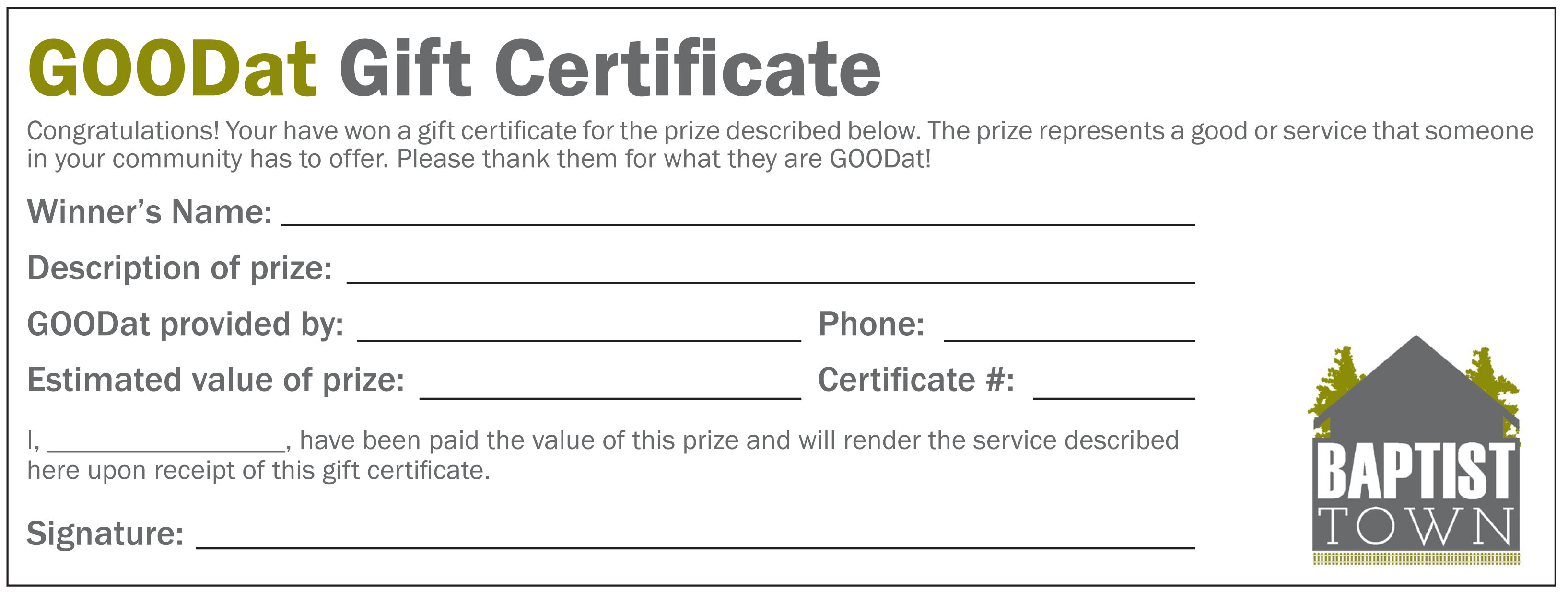
While many resident shared what they are GOODat through activities, others wrote on the GOODat chalkboard (to be hung in the neighborhood community center when it is complete), shared their stories of growing up in Baptist Town with the event videographer Dash Brown, or included their skills as a door prize in the form of a GOODat gift certificate. Raffle winners could choose from a hair cut, nail art, dance lessons, or car detailing from their entrepreneurial neighbors.
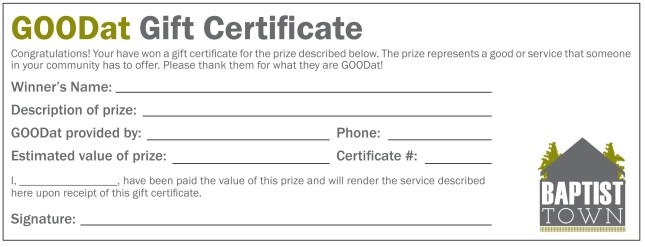
GOODAt gift certificate

Throughout the day and the planning process, I was impressed with the many volunteers who shared their time and efforts and the support from the greater Greenwood community (especially the City Public Works Department). As we asked each other, “What’s your GOODat?”, I believe we were acknowledging that we are all valuable, and that was the magic of the day: each individual and what they contribute to the community by simply showing up.