can community action be easy?

The Greenwood team returned from the Sustainable Cities Design Academy last September inspired and with new knowledge about how to create sustainable change throughout the city. Though we each have incorporated the discoveries made at SCDA into our ongoing work, team members expressed concern about fitting additional important projects into our already busy schedules. Through the fall we formulated a plan to avoid letting plans to positively impact the health, education, and social and economic equity of area residents fall by the wayside.

SCDA team members started by inviting others to be part of a group that would be committed to sustainable efforts in Greenwood. In subsequent meetings the group decided that we should find our footing and identity through light, quick, cheap community projects. Members of the group have committed to completing one small but visible project (taking only 4-8 hours to plan) each month in 2014.

Expanding the knowledge, interest and availability of bike culture is a topic that has continued to come up in sustainability conversations. Toward that end, four of the group members chalked “share the road” symbols on a route throughout downtown and an adjacent residential neighborhood. This route could potentially become a permanent biking route if the City sees public support for our project. For now, we got a lot of attention from curious drivers who saw us out with the stencil and chalk spreader on a chilly Thursday night. The following Saturday, group members met to bike the route together, similar to the Critical Mass rides that are common in many cities. We had a small turn-out, but we learned a few things about bike lanes, chalk spreaders, and our community through the process. Most importantly, many people have asked if any more rides are planned. There aren’t any yet, but we are working on our February initiative now, and are excited to see how the year unfolds.
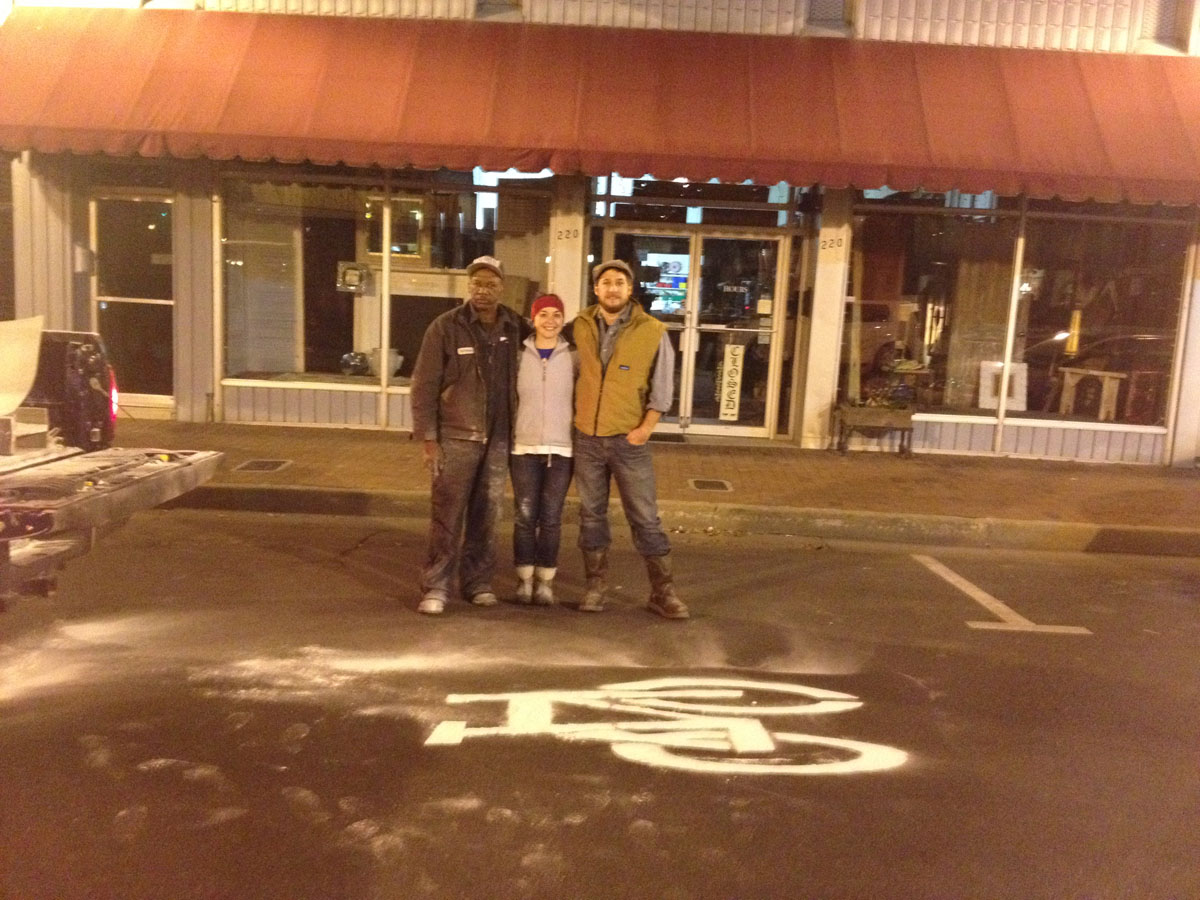
January recap:

  • Chalk “share the road” symbols and bike ride
  • Time: 4 hours
  • Project team members: 4
  • Project cost: $7.75

Thanks to Richard Elliott and Davis Pratt for the photos.

“The Heart of Hale County” gets to the root of the question

You’ve heard about the Rural Studio, and Hale County. Maybe you’ve even watched the movie Citizen Architect, but you should also read this article if you are interested in equity, design, and change. Rob Walker’s The Heart of Hale County, featured this month in Fast Company magazine, takes an in depth look at the social innovation work that has been taking place in west-central Alabama for the last two decades. But the writing is relevant to change makers working around the globe. In addition to details about work in Hale County, the article takes readers through a conversation about the most pressing questions in social impact design and architecture. Can outsiders be effective change makers in an unfamiliar place? How is success defined within the field of public interest architecture? Walker’s writing vacillates from triumphant to daunted, taking the reader along on his journey. In the end, what remains are questions, which is apt for a field trying to define itself within the context of today’s most complex and variable challenges.

Walker writes, “It’s worth celebrating design’s social successes, but it’s also worth openly assessing the limits. The potential of design to enable change has been established; maybe the promising paths forward involve the humility to recognize that lasting change is harder than it looks, and the willingness to openly debate and disagree on how to integrate differing design approaches into more wide-ranging solutions with a range of partners.”

at rural studio 8_13

photo credit Richard Elliott, during our visit to the Rural Studio, August 2013

hands on at MSU

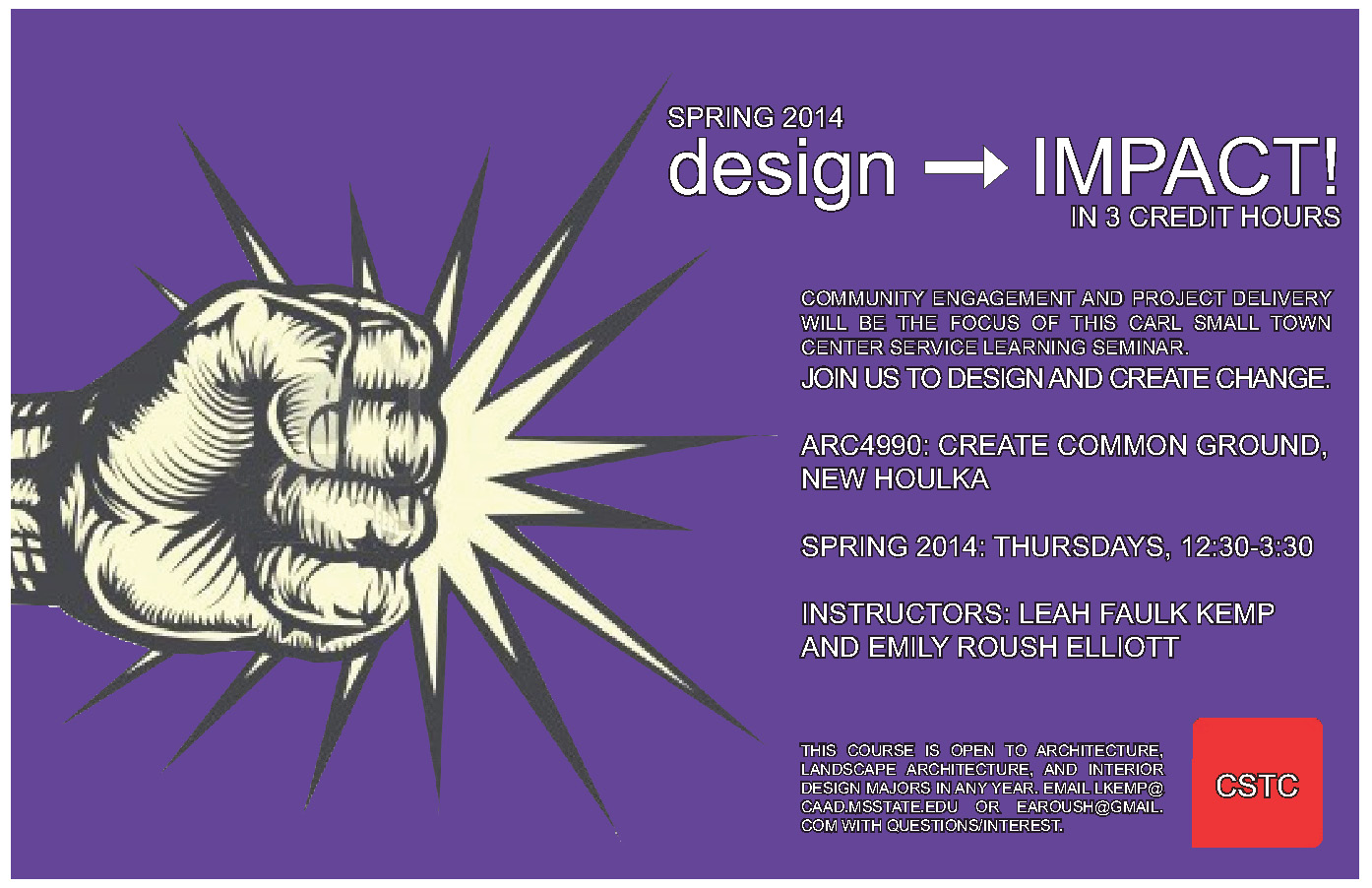
CREATE class poster

Next week I will begin co-teaching my first architecture course at Mississippi State’s CAAD (College of Art, Architecture and Design). In this community engagement seminar sponsored by the CREATE Foundation, Leah Faulk Kemp and I will guide students through the process of engaging residents of the small town of New Houlka. As in previous years, the class will wrap up with a document in which students propose design solutions based on the goals and needs articulated by the community. In addition, this year’s class will implement one small scale project, giving students experience in the surprises that come with project implementation.

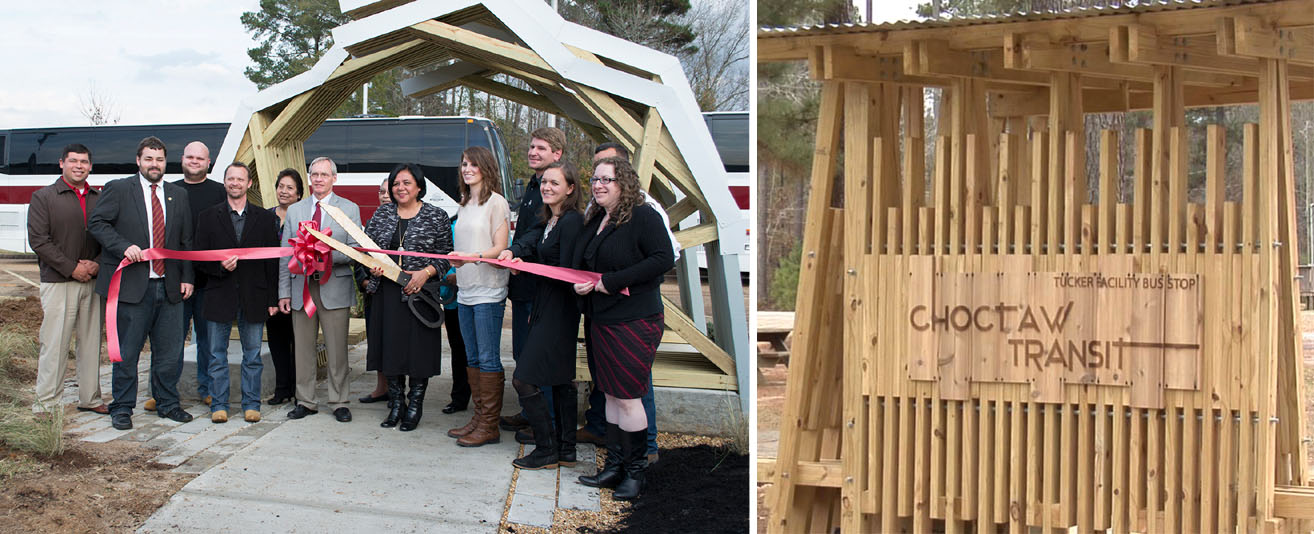
Also at CAAD, the Collaborative Studio ended the fall semester with a ribbon cutting. Students completed construction of two bus shelters for the Mississippi Band of Choctow Indians. Their work is a continuation of CAAD’s relationship with this community built upon a previous design-build bus shelter and various design and consultation services provided by CSTC since 2009. Read more about the class and the bus shelters here.

MSU Collaborative Studio A13

a message from Enterprise

On any given night, 630,000 people in the United States are homeless. One in six of these people is a veteran and one in five has a child to support.

With your support, we can begin to change these conditions through the thoughtful design of affordable, supportive housing for formerly-homeless populations; design that promotes physical and mental wellbeing, recovery, and community.

Design makes all the difference for at-risk populations. Star Apartments in downtown Los Angeles is a perfect example. Since completing her fellowship in 2012 with SkidRow Housing Trust, Enterprise Rose Architectural Fellow Theresa Hwang has continued to use her design background to direct the development of this pivotal project. The results; 102 apartments for formerly homeless individuals; the first mixed-use, multi-unit supportive housing project employing entirely green construction methods in Los Angeles.

Please help support our mission through our year-end CrowdRise Holiday Challenge. Plus, thanks to a generous grant from The Kendeda Fund, your contribution will be matched, dollar for dollar! To date, we are at 50% of our fundraising goal and the Holiday Challenge ends January 9th at noon.

Again, my deepest thanks for supporting our work over the years, and thank you in advance for your support during the Holiday Challenge.

Best wishes,

Katie Swenson

And, if you donate $50 or more from January 5th at 12pm EST – January 8th at 12pm EST, you will automatically be entered to win a Droid Ultra Smartphone!

skidrow for blog

jobs today, houses tomorrow

The Baptist Town neighborhood has austere statistics in terms of the poor quality of housing, low home ownership rates, and homelessness. These challenges largely inspired the Baptist Town Neighborhood Revitalization and are among the primary reasons that my fellowship exists. Despite this great need, plans to install a minimum of eleven new homes in the neighborhood could not be brought to fruition this year for a number of reasons. After initially being devastated by what felt like a failure, my hosts and I rallied around the myriad other ways to positively impact Baptist Town. Safer, more attractive pedestrian routes were created at the entry points to the neighborhood, we completed two parks, a playground, new signage throughout Baptist Town, and held the largest Community Day celebration to date, GOODat Day.

Large park and playground

New seating, shade structures, and the playground in the background.

Each of these activities reminded us that as important as housing is, it is one component of the multi-faceted approach needed to bring about long-term change in this neighborhood. One of my hosts, the Greenwood-Leflore Economic Development Foundation, provided the leadership that allowed us to respond to one of the other great needs in Baptist Town: employment. Building upon the skills residents shared during GOODat Day, we offered a competitive small business grant. We awarded the grant two weeks ago. Along with the funds, two grant winners have received business cards and will participate in four question and answer sessions with local experts who can help guide their fledgling businesses.

Angela and Roger front page news

Economic Development Foundation Executive Director, Angela Curry, and GOOD@ Small Business Grant winner Roger Williams made front page news

Our grant winner has already reported that because of the equipment he was able to buy with the grant funds he has been able to continue detailing cars in cold weather and his profit margin has increased. Though we are working hard now in hopes of beginning the housing component of the neighborhood revitalization as early as January, this work has given us insights into how to more holistically respond to the needs of the Baptist Town community. As the first year of my fellowship quickly wraps up, I am looking forward to a second year in which new homes are realized, and we can support this work through education, health, and employment related initiatives.

for to be free…

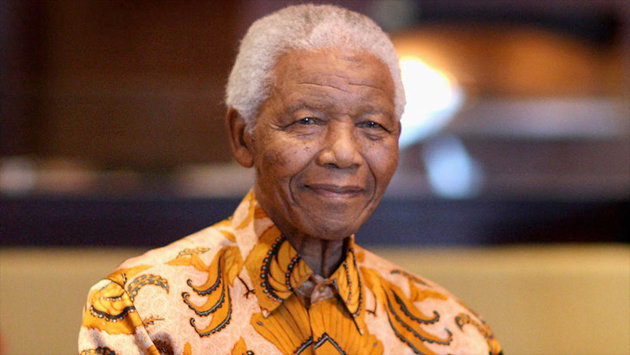
“For to be free is not merely to cast off ones chains, but to live in a way that respects and enhances the freedom of others” – Nelson Mandela

This quote is on the back of my business cards. I love it because it avoids all of the terms I dislike that are hard to disassociate with public interest work. It does not say anything about “helping the needy”, “giving to the poor”, or “providing for the underprivileged”. It asserts that in respecting others we are generous, humane, and do not live exorbitantly.

The discussion about when efforts to help actually hurt the target audience is an important one. Within that conversation, I believe that an important step in avoiding a project with negative outcomes is checking that the work is motivated by respect for the people served, rather than charity.

d55f577e-ab83-4ed7-952c-4f0383bad3a9_nelsonmandela_gallery_gs

upcoming ACSA conference

102-annual-homepage-programpagebanner

The Association of Collegiate Schools of Architecture’s call for this years papers invited submissions on a variety of topics, all related to the global nature of architectural practice today. The number of topics related to socially impactful work is encouraging. Even more exciting is the acceptance of a paper that Leah Faulk Kemp, Assistant Director of the Carl Small Town Center (CSTC), and I co-wrote. Our paper, titled Building Social Building, presents four lessons learned through the work of CSTC as instructive in implementing community driven design projects. We can’t share the paper until after our presentation, but here are some soundbites:

  • Public Interest design has trust issues.
  • Public interest architecture is public; this means it’s political.
  • Social impact design is about more than three bottom lines.
  • Social impact work must be impactful.

We will share more about the paper and our presentation in April!


awesome GOODat day video

As soon as we thought up the GOODat theme for Baptist Town Community Day, I thought of Dash. A long time resident of the neighborhood, he films many of the talented rappers in the neighborhood, and he is good at it. Thanks to Dash, we have great documentation of an awesome day.

More video clips from GOODat coming soon.

soft metrics

I believe strongly that design and thoughtful implementation add value to every project, but social impact work takes place in such a complex and variable environment that tracking outcomes based on specific projects is rare and imperfect. As I mentioned in my last post, we may not even know of the positive or negative ripple effects our work is having. Despite this, I also believe it is the responsibility of social impact designers to make an effort to document metrics associated with their work.

If we want the field of public interest design to grow, and funding to be dedicated to the projects and the jobs we believe make the world a better place, there is no alternative to demonstrating a compelling value proposition.

Rebekah Levine Coley, a professor at Boston College’s Lynch School of Education, and her colleagues from Tufts University make just such a proposition through a six-year long study that tracked the development of 2,400 low-income children within poor families. The research concluded that “the quality of a child’s home predicted academic success and susceptibility to emotional and behavioral issues” more strongly and consistently than any other factor.  As Emily Badger writes in her report on the study, the breadth and depth of the research is important because it indicates causation over correlation. Read an excerpt below or the entire article here.

In retrospect, that study amassed precisely the kind of data you’d need to understand how housing itself – not the social environment of a “family home” – might influence children. The study recorded whether a home was rented or owned, or rented through public housing or subsidies, how affordable it was relative to a family’s income, how often families moved from house to house, and the quality of the property. Researchers looked for working refrigerators, holes in the wall, rodents, functioning heat and hot water, adequate light and fresh air – many of them signs of poor-quality housing outside of a family’s control. All of the families were low-income, but some had considerably more run-down housing than others.12837889-old-and-weathered-grey-barn-wall-with-empty-hole-from-broken-and-missing-barnwood-board-showing-aged

Controlling for other factors like a parent’s employment status and income, Coley and her co-authors concluded that the poor quality of housing more strongly and consistently predicted a child’s well-being than all of those other housing characteristics (including whether the home was considered “affordable” to the parents or not). Children in more derelict housing had lower average reading and math skills. They had more emotional and behavioral problems.

The information presented in this study is important in gaining traction for the broad assertion that where a person lives shapes who they are. As stated above, the breadth of this study is important, but public interest designers, rather than be daunted by the idea of studying 2,400 of anything, should see their own projects as an opportunities to reinforce the study on a case by case basis.

I am new to metrics, and am beginning to delve deeper in two ways. First, by frequently asking myself, “What are the intended outcomes of my work in Mississippi?” I have tasked myself with assigning three specific outcomes to track to the Baptist Town Cottage project by the end of November. I will then measure these outcomes before, during and after construction.  Of those three, I would like one of them to be a “soft metric” – something that is not numerical, hard to measure, and tied to well-being similar to Coley’s study.